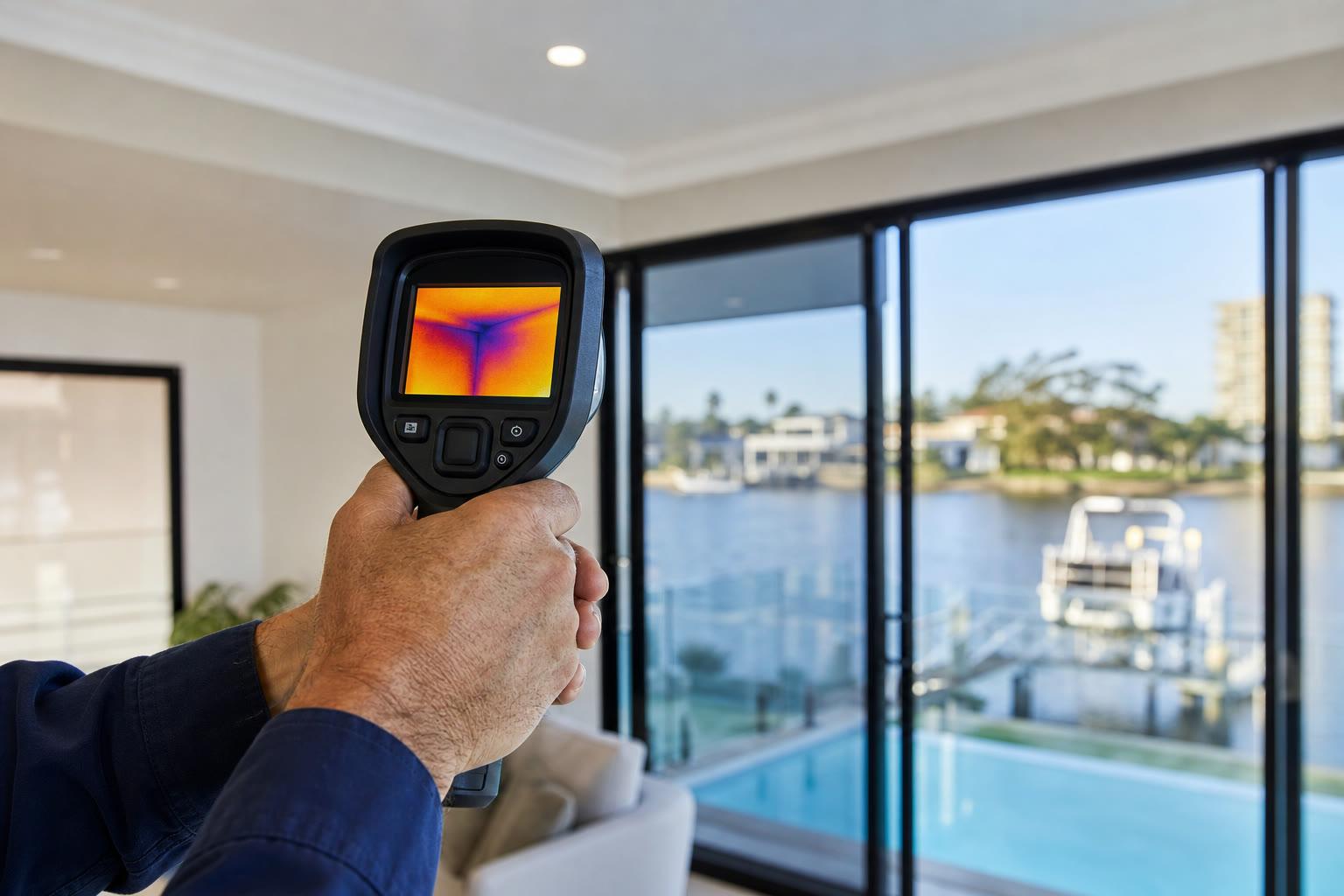
Thermal imaging in a building inspection reads surface temperature differences and shows them as a colour image. It can point to moisture, missing ceiling insulation or damp under flat roofs. It cannot see inside walls or confirm a cause. An inspector checks any flagged area with a moisture meter before it goes in the report.
Buyers hear 'thermal camera' and picture X-ray vision. It is not that. A thermal imager records how warm or cool a surface is and paints the difference as colour. What that difference means is a matter of judgement, and a clear image can be as limited as a flagged one.
This article explains what a thermal imager shows, what it can point to in a large Gold Coast home, and where it runs out. It also shows how the result is written up, so you can read the thermal section of a report knowing its edges. A larger home is a different job: more wet areas, more flat roof, more glass.
Key Takeaways
- A thermal imager shows surface temperature differences only. It does not see inside a wall, a floor or a roof.
- In a large home it can point to moisture behind tiles, damp under flat roofs and terraces, and missing or displaced ceiling insulation.
- Furniture, stored goods, weather on the day, thick masonry, stone cladding and glass all limit what the image can show.
- A flagged area is a prompt, not a diagnosis. A moisture meter reading and, where needed, a suitably qualified specialist come next.
- At Prestige, thermal imaging and moisture readings are included in every inspection. They are not an add-on.
At a glance
| Area | What thermal imaging can show | Where seeing stops | What follows |
|---|---|---|---|
| Ensuites and balconies | A cool patch where moisture may sit behind tile | Cannot see the waterproofing layer itself | Moisture meter reading, then a further opinion if high |
| Flat roofs and terraces | A cool or uneven patch on the ceiling below | Water can travel, so the patch may not sit under the leak | Moisture reading, drone photographs, waterproofing specialist if needed |
| Ceiling insulation | Thin, missing or shifted insulation | Limited where the ceiling cannot be scanned | Roof space check where safe access exists |
| Masonry, render and stone cladding | Sometimes a pattern at the surface | Thick, dense material can hide what is behind it | Moisture readings at accessible points |
| Glass and polished surfaces | Mostly reflections | Cannot see through glass | Visual inspection and moisture readings on adjoining walls |
| A clear result | No surface pattern stood out on the day | Does not prove the building is dry | Read what was scanned and what was not reachable |
What does a thermal imager actually show?
A thermal imager shows surface temperature differences as a colour image. It measures infrared energy leaving the surface of whatever it is pointed at. It does not see inside a wall, under a floor or behind a tile. It reports how warm or cool the surface is, and nothing more.
Every surface gives off infrared energy. The camera converts that energy into a picture, usually with warmer areas in brighter tones and cooler areas in darker ones. The colours are a code for temperature, not a view of the material.
So why does it matter in a building? Because what sits behind a surface can change that surface's temperature. Damp material usually behaves differently to dry material, because water evaporating from a surface cools it and water changes how heat moves through the material. Missing insulation changes how heat passes through a ceiling. The camera sees the effect, not the cause.
That makes thermal imaging a screening tool. It tells the inspector where to look closely. It does not make an inspection invasive, and nothing is cut open or lifted. The inspection stays visual, extended by a tool that shows patterns the eye cannot.
What can thermal imaging point to in a large Gold Coast home?
In a large home, thermal imaging can point to moisture behind tiles in ensuites and on balconies, damp under flat roofs and terraces, and missing or displaced ceiling insulation. These are places where a surface temperature pattern often follows a real change underneath. Each one still needs a moisture reading before anyone calls it damp.
Prestige works across four kinds of prestige property: units and penthouses, prestige homes (beachfront and dry-block), waterfront homes, and acreage and estates. The thermal work matters in all four. It matters most in the larger houses, where the number of wet areas, the amount of flat roof and the area of glass all rise together.
Moisture behind tiles in ensuites and on balconies
A large home often has several ensuites, a powder room, a laundry and an outdoor shower. Each is a wet area, meaning a room or space where water is used and a waterproofing layer sits under the finish. Balconies add another: a tiled balcony over a living area puts a waterproof membrane directly above a ceiling.
If water gets behind a tile, the tile surface can read cooler than its neighbours. The imager scans the wall, the floor edge and the ceiling below a balcony. A cool patch tells the inspector where to put the moisture meter. The imager cannot see the membrane. It sees what the membrane's failure may have done to the surface.
Damp under flat roofs and terraces
Flat roofs and terraces are common in prestige homes. A flat section may sit over a garage, a terrace may sit over a living room, and a penthouse may have both. Water finds these places in a $5 million home exactly as it does in any other.
The imager is aimed at the ceiling below. A cool or uneven patch can point to damp in the roof structure above. One caution applies. Water can travel along a slab or sheeting before it shows, so the patch may not sit directly under the point of entry. That is one reason a thermal image is a starting point.
Missing or displaced ceiling insulation
Ceiling insulation sits in the roof space, out of sight. Scanned from below, a ceiling with thin, missing or shifted insulation can show a different temperature pattern to its surroundings. A rectangle that reads differently to the room next to it is a typical sign.
The inspector can then check the roof space where safe access exists. Where there is no access, the image is the only clue, and the report says so.
What are the limits of thermal imaging?
Thermal imaging is limited by what stands in the way, the temperature conditions on the day, and the wall material and thickness. It also cannot see through glass. Where any of these apply, a clear image tells the inspector less than it appears to. An anomaly is a prompt, not a diagnosis.
Obstructions: furniture, rugs and stored goods
The imager reads the surface it faces. If a wardrobe, a sofa, a rug or a wall of stored boxes covers that surface, the imager reads the cover. A furnished home hides the lower part of many walls and the floor edges, which are exactly where moisture often shows first.
A visual inspection works with what can be reached and seen on the day. The report records areas that were not accessible, so a reader can see which parts of the house the thermal scan did not cover.
Ambient temperature and conditions on the day
Thermal imaging works on differences. If a damp surface and a dry surface sit at much the same temperature as the air around them, the difference is small and the image mutes it. A small temperature difference gives a weak result.
Conditions change what surfaces are doing: direct sun on an outside wall, air conditioning running in one room and not the next, or a cool morning following a warm night. The inspector reads the image with those conditions in mind, and does not treat a clear image on a poor day as strong evidence.
Wall material and thickness
Masonry, rendered block and stone cladding are thick and dense. They store heat and release it slowly, which smooths out the surface differences that the imager relies on. Moisture behind thick stone or heavy render may not show at the surface at all.
This is a real limit in prestige homes, where these materials are common. On such walls the moisture meter does more of the work, and it reads only the material it touches or sits against, to a limited depth.
Glass and reflective surfaces
Glass does not let thermal imagers see through it. It reflects infrared the way a mirror reflects light, so the camera shows the inspector's own heat or a window across the room. Polished stone, stainless steel and glossy tiles can do the same, and the reflections can look like patterns.
Long runs of glazing also mean fewer wall surfaces to scan. A home with a lot of glass gives the imager less to read.
An anomaly is a prompt, not a diagnosis
A thermal anomaly is a temperature pattern that stands out from its surroundings. It is the start of a question. Prestige reads any defect the same way: what can be seen, what it means, and where seeing stops.
- The visible sign: a cooler or uneven patch on a ceiling, wall or floor.
- What it usually points to: moisture, a change in materials behind the surface, or missing insulation.
- What a visual inspection cannot confirm: the cause, the extent, and whether anything hidden has been damaged.
- Who gives the further opinion: a suitably qualified specialist, such as a waterproofing specialist, damp specialist, roofer or licensed builder.
Why is thermal imaging used with a moisture meter?
The imager flags a cool patch, and the moisture meter checks whether that patch is damp. Neither tool is enough alone. The image tells the inspector where to put the meter, and the meter tells the inspector whether the temperature pattern has moisture behind it or a simpler explanation.
Simpler explanations are common. A cool spot can sit near an air-conditioning vent, at a change of material, or on a wall that spent the morning in shade. The meter separates these from a damp area. It reads the moisture in the material it touches, so a flagged patch with a normal reading is recorded as such, and a flagged patch with a high reading is recorded as a finding.
MEC Builders' sample report shows how a reading is treated. It records moisture meter readings and lists what a high reading can come from: poor ventilation, ineffective drainage, leaking roofs, defective flashing (the metal strips that seal roof junctions) or concealed termite activity. It says high moisture should be investigated further to find the cause and the extent of any damage. A reading is where the questions start, not the diagnosis.
Flat roofs and balcony membranes
Take a three-level canal home with a tiled roof over the top floor and a flat section over the garage. This is an illustration, not a real inspection. From the ground and a ladder, the tiled slopes facing the street can be seen. The drone photographs the back slopes, the valleys, the box gutter (a concealed gutter) beside the flat section and the top of the high walls.
The thermal imager covers a different part of the problem: the ceiling under the flat section and under any terrace. A cool patch there is checked with the meter. The result is a roof section built from photographs of the whole roof and readings from the rooms below, not from the part that happened to face the driveway.
The membrane itself, the waterproof layer under a flat roof or a balcony finish, is something none of these tools can see. The inspector sees its surface, its junctions and its drainage points, and reads the effect on the rooms beneath. Where the findings point to a failing membrane, the report says so and says why. The page on flat roofs and waterproofing explains what a visual inspection can and cannot establish on these areas.
How do you read the thermal section of your report?
Read it for three things: what was scanned, what was found, and what was not reachable. A clear result is written as 'No thermal anomalies were detected', as in MEC Builders' sample report. A flagged result gives the location, an image and a moisture reading, then says what should happen next.
What a clear finding means and does not mean
When the wording is 'No thermal anomalies were detected', it means that on the day, in the areas the imager could read and under the conditions present, no surface temperature pattern stood out.
It does not mean the building is dry. It does not mean the waterproofing is sound. It does not say anything about thick masonry that hid a pattern, glass the camera could not see through, or a wall behind a wardrobe. Read the wording alongside the report's list of areas that were not accessible.
How a flagged anomaly is written up
A flagged item has the same parts each time:
- Location: the level, the room and the surface, for example a ceiling below a terrace.
- Image: a thermal image set beside an ordinary photograph, so the reader can match the pattern to the place.
- Moisture reading: the meter result at that point, and at a comparison point nearby.
- What it can point to: stated in plain words, with the limits of the tool.
- The next step: further investigation, and where the finding needs another opinion, who should give it and why.
MEC Builders' sample report shows how this reads in practice. Its summary table at the front lists every significant item with a number that leads to its place in the report. In the deck section, it records fungal decay in a section of the bearers or joists (the timbers that hold a deck up), classes it as a safety hazard needing repair, and recommends a qualified carpenter replace the affected timbers. The sign, the class and the action are all in one entry.
What sits alongside the thermal work
Thermal imaging and moisture readings are part of every Prestige inspection, not an add-on. They sit inside a building and timber pest inspection that follows AS 4349.1 and AS 4349.3, the Australian Standards for pre-purchase building inspections and timber pest inspections, and they extend what that inspection can find without opening anything up.
A standard report covers the house: structure, roof and exterior, interiors and wet areas, and timber pests. A Prestige inspection adds a drone survey of the roof on every house and acreage property, the pool barrier and, on waterfront homes, a visual inspection of the revetment wall. One licensed inspector does all of it and writes the report, which arrives the same day in most cases. How the inspection works sets out the full scope, and the starting fees are published for each kind of property.
MEC Builders publishes a sample building and pest report, so the way readings and findings are laid out can be read before booking.
Why a clear thermal image on a large home deserves a second question
A clear thermal result on a larger home is weaker evidence than the same result on a plain house, and the report should be read that way.
Thermal imaging reads easily on plain painted ceilings and thin walls. Large homes often have the opposite: stone cladding, thick render, rendered block, long runs of glass and polished finishes. The surfaces the imager has to read are often the ones it reads least well. Expensive finishes are not evidence of a sound building. They are often the layer that hides it.
This is why a larger home is a different job, not a longer version of the same one. On these properties the moisture meter does more of the work at the wet areas, and the drone does the work on the roof that nobody can walk. The thermal image still has a place. Its value is in telling the inspector where to put the meter, not in producing a headline result.
When you read 'No thermal anomalies were detected', ask three things:
- Which levels and rooms were scanned, and did that include the ceilings below every terrace, balcony and flat roof section?
- Which areas were covered by furniture or stored goods?
- Which walls were stone, thick render or glass, where the image says less?
A report that answers those questions plainly is worth more than one that only reports a clear image. A report is only worth what the buyer understands of its edges.
References
Questions people ask
Can a thermal camera see through walls?
No. A thermal camera reads infrared energy from the surface it faces and shows it as a colour image. It cannot see inside a wall, behind tiles or under a floor. It can show a surface pattern that follows something behind it, which then needs a moisture reading and a visual check.
Is thermal imaging included in a Prestige inspection, or is it an add-on?
It is included. Every Prestige inspection covers thermal imaging and moisture meter readings alongside the building and timber pest inspection. Fees start from $1,089 for a unit or penthouse, $1,430 for a prestige home, $1,650 for a waterfront home and $1,760 for an estate or acreage, including GST.
Can thermal imaging find termites?
Not on its own. A thermal imager cannot confirm termite activity. MEC Builders' sample report lists concealed termite activity as one possible cause of a high moisture reading, so a flagged area can prompt a closer look. The timber pest inspection to AS 4349.3 is the check, and a pest manager gives any further opinion.
Does the weather affect a thermal inspection?
Yes. Thermal imaging works on temperature differences, and a small difference between surfaces and surroundings mutes the result. Sun on a wall, air conditioning running in one room or a mild still day can all change the image. The inspector reads the image with the conditions on the day in mind.
What does 'No thermal anomalies were detected' mean?
It means that on the day, in the areas the imager could read, no surface temperature pattern stood out. It does not mean the building is dry or the waterproofing is sound. Furniture, thick masonry, stone cladding and glass all limit what the image can show, so read the wording with the list of areas that were not accessible.
General information about buildings on the Gold Coast. It is not advice on a purchase, and no legal advice is offered.
Written by Prestige Building Inspections, the prestige inspection service of MEC Builders. QBCC licence 1268733. About Prestige